

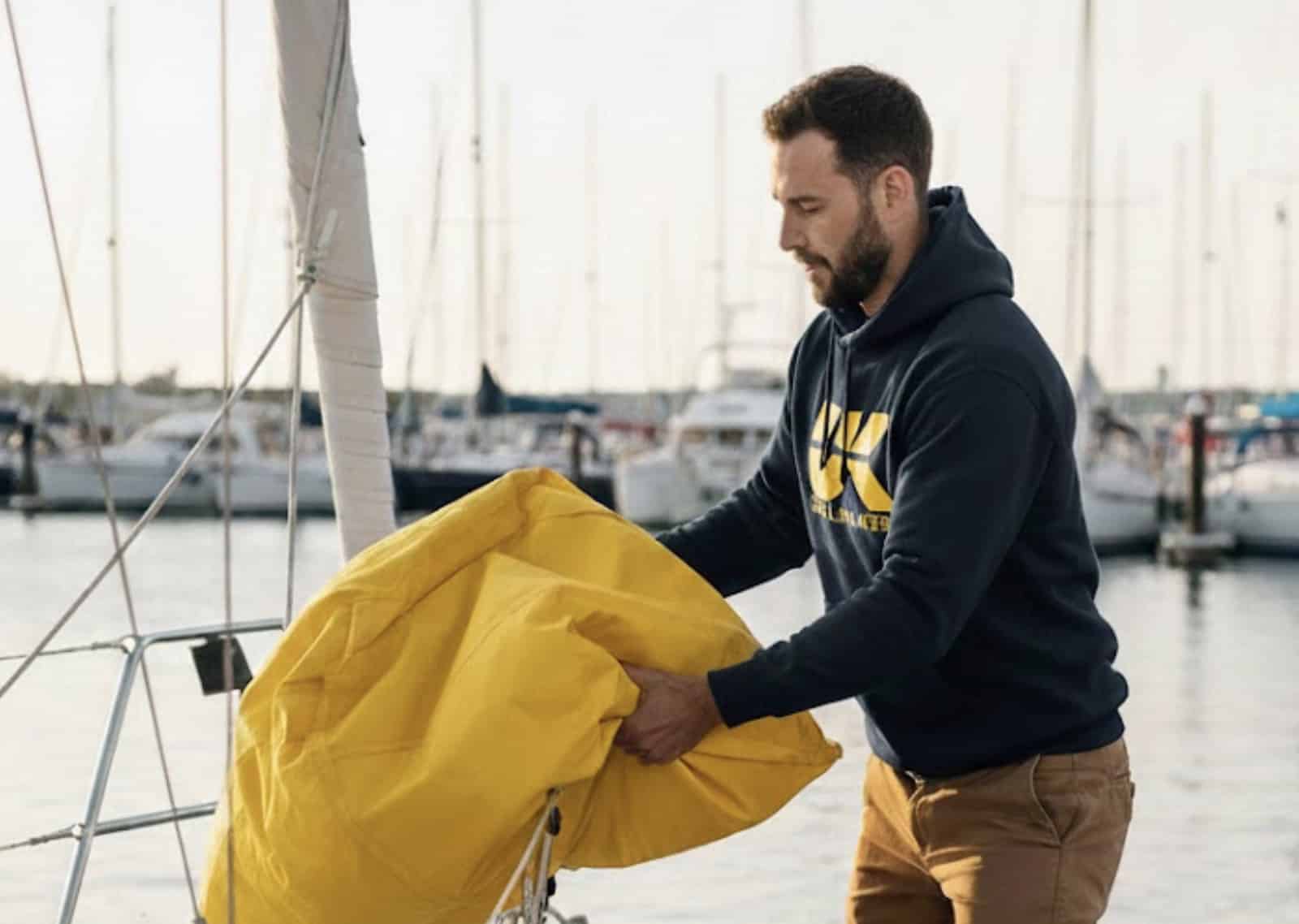
If you’re bringing your sails into the loft for service or storage using a drawstring sail bag, you may be staring at that gold UK Sailmakers bag that’s been stashed below deck for months, or even years, wondering how your sail will ever fit. Trust us: over the years, our lofts have seen some very creative folding techniques!
Getting your sails serviced before the spring sailing season is key to keeping them performing at their best, and catching small maintenance issues early can help prevent costly repairs down the road. Your local UK Sailmakers loft can inspect, repair, or clean your sails, and if you’re thinking about a new one, this is the perfect time to plan for spring delivery. We can help you create a multi-year plan to suit your needs, budget, and sailing goals.
Some UK Sailmakers lofts also offer collection and installation services to make it easy to bring your sails in for repair, winter storage, or return. But if you’re dropping your sails off yourself and are wondering how to fit them into a standard drawstring bag, follow this step-by-step guide—it will save you time and make your sailmaker’s job easier.

How to Pack Your Sails
Step 1: Remove any battens and sheets from the sail and lay it out on a clean, flat surface—like a dock finger, sailing club lawn, or other smooth area. Avoid dragging the sail across rough concrete or other hard, abrasive surfaces.
Step 2: Flatten about an arm span’s width of the foot, keeping the remainder of the sail neatly piled beside it without twists.
Step 3: Grip the foot of the sail while holding the section for your first fold taut. Keep the height of your drawstring bag in mind and make folds slightly narrower than your sail bag’s height to ensure a good fit.
Step 4: Continue flaking the sail back and forth, staying between the tack and clew, all the way to the head. You don’t need to stack the luff like you would for a racing sail “sausage bag,” though you can if you prefer.
Step 5: Fold over the tack edge over, then roll the sail toward the clew.
Step 6: Secure the rolled sail with sail ties and slide it into your drawstring bag. Done!




Always easy to do on a “clean flat surface like a dock or a lawn”. I’d like to see a video folding a 155% genoa on the foredeck.
Hi Dan,
Thanks very much for your feedback. I completely agree — a clean, flat surface like a dock or lawn makes flaking a sail much easier, and doing a 155% genoa on a foredeck definitely adds another level of difficulty.
This video is intended as a simple, step-by-step guide to the process. If you have a slip with a narrow finger beside the boat, one approach that often works well is bringing the foot of the sail onto the finger and having someone on board feed the sail down to the flakers as they work. But when you are restricted to folding entirely on deck, it is definitely a skill that takes practice, especially if you are underway. Deck layouts vary a lot, but with a 155% sail, it is never going to be easy.
There are not many hidden tricks. The fundamentals are the same, but it comes down to assessing whether it makes more sense to lay the sail inside or outside the shrouds to create the least obstructed path to start. In most cases the foredeck offers the most open space, so planning to stack the luff there usually works best. The person at the tack end will need to make wider folds than the person at the clew to keep the stack aligned. As you move higher up the sail, the difference between luff and leech fold widths will naturally decrease. If you are underway in breeze, it can be helpful for the clew-end flaker to carry a few sail ties in their PFD and secure completed flakes as they go, removing them again before rolling the sail.
If you are using a sausage bag, the process can be a bit easier. Laying the bag out unzipped under the sail before you start allows the clew-end flaker to zip it up progressively, helping keep the sail contained as you work. I will definitely keep your suggestion in mind for a future video!
Best regards,
Heather