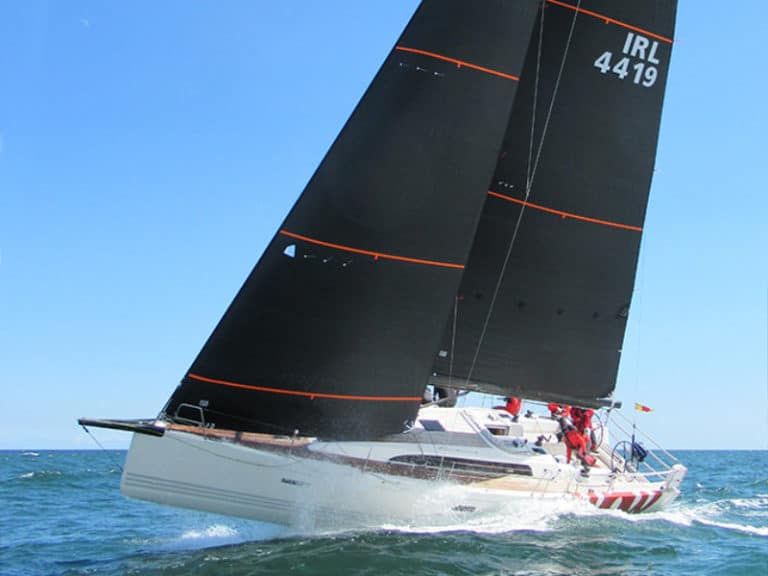
RACING MAINSAILS
X-Drive Racing Mainsail
The performance of continuous load-path yarns with the durability and price that club racers and performance cruisers actually want.

Why X-Drive?
UK Sailmakers’ X-Drive sails are the preferred choice for sailors who want the performance of continuous-yarn sails, but also want sails that are durable and affordable. Because they deliver on all three counts, X-Drive has proven to be the ideal choice for racers, club racers, and performance cruisers alike.

Holds Its Shape
Continuous load-path yarns
A grid of high-strength yarns runs corner to corner like a building’s steel skeleton — carrying the loads while the panels define the aerodynamic shape.
No Seam Creep
Yarns bridge every seam
Because the continuous yarns cross the panel seams, seam creep and catastrophic failures are eliminated — so the sail keeps its designed shape.
Smart Value
Performance you can afford
The skin’s only job is shape, so it can be a lighter, less-expensive laminate — all the strength comes from the bonded fiber grid, which keeps the cost in check.
How X-Drive Is Built
X-Drive is a two-part construction method. First, lightweight laminated sailcloth is cut into cross-cut panels with shaped seams; once those broad-seamed panels are assembled, the sail has exactly the aerodynamic shape the designer created.
Then UK Sailmakers uses proprietary machines to lay down a grid of continuous, high-strength, low-stretch yarns that run corner to corner along the sail’s primary load paths. They work like the steel skeleton in a tall building — the yarns carry the highest loads while the paneled skin defines the shape. And because the surface only has to provide that shape, it can be a lighter, less-expensive laminate, which keeps the price in check.


Depending on the sail you choose, those yarns can be carbon fiber, Endumax, or S-Glass. A grid of carbon yarns on a laminate with a black aramid scrim gives the sail an all-black look; for sailors who prefer the traditional all-white appearance, X-Drive Silver delivers the same construction in white.
Choose Your X-Drive

X-Drive Carbon
Description:
Load-path-reinforced construction for performance cruising and club racing.
Material:
Carbon-fiber load-path yarns applied 11 at a time along the sail’s computer-predicted load paths — the strongest, least-stretchy yarn used in sailmaking.
Shape Stability:
★★★★★
Durability:
★★★★
Price:
$$$$

X-Drive Silver
Description:
Load-path-reinforced construction for performance cruising and club racing, with a traditional all-white appearance.
Material:
S-Glass load-path yarns applied 11 at a time along the sail’s computer-predicted load paths — more stretch than carbon, but less expensive.
Shape Stability:
★★★★
Durability:
★★★★
Price:
$$$$
FAQs
What is X-Drive construction?
It’s a two-part method. First, lightweight laminate is cut into cross-cut panels and broad-seamed to the designer’s exact 3-D shape. Then a grid of continuous, high-strength yarns is bonded over the panels along the sail’s load paths — like the steel skeleton inside a building. The yarns carry the loads; the panels define the shape.
How does X-Drive stop seam creep?
The continuous load-path yarns run right across the panel seams and are bonded over them. That bridging is what eliminates seam creep and the catastrophic seam failures that can ruin a paneled sail — so the sail holds its shape.
What’s the difference between X-Drive Carbon and Silver?
Carbon uses carbon-fiber yarns — the stiffest, lowest-stretch option, with the best shape stability and a distinctive all-black look (carbon on a black aramid scrim). Silver uses S-Glass yarns, which stretch a little more but cost less and give the sail a traditional all-white appearance.
Who is X-Drive for?
Racers, club racers, and performance cruisers who want much of the shape-holding of a continuous-yarn sail, but with more durability and a friendlier price than a fully molded laminate.
Why is X-Drive more affordable than a fully laminated sail?
Because the sail’s skin only has to provide the shape, it can be a lighter, less-expensive laminate. All the strength comes from the bonded grid of continuous fibers — so you’re not paying for an exotic structural membrane across the entire sail.