When the Forecast Gets Dicey
You’re reading the forecast for a delivery up the coast. The window looks fine. Then there’s a low pressure system that might come through 36 hours in. You start asking yourself the question every cruiser asks at some point: if it starts blowing dogs off chains, do I have the right sails on board?
This is not a paranoid question. While serious offshore or coastal racers and cruisers generally have both a storm jib and a trysail onboard, the honest answer for most cruising boats is no. The factory inventory you bought with the boat might only include one furling genoa or jib, a mainsail, and a cruising spinnaker, none of which were designed for sustained winds of 30 knots or more.
A storm jib is the answer if you sail in conditions where a real gale is possible. It is not the answer for everyone. This page walks you through what a storm jib actually is, when you need one, when you don’t, and how to choose the right one for your boat. UK Sailmakers has built storm jibs for offshore racing programs, bluewater cruisers, and weekend sailors who simply wanted a backup plan. The right answer depends on where you sail and how far you go.
What Is a Storm Jib?
A storm jib is a small, heavy headsail flown when the wind is too strong for any other jib on board. The standard definition under World Sailing’s Offshore Special Regulations puts the maximum area at 5% of the foretriangle height squared, with a luff length no longer than 65% of the I measurement (the foretriangle height from deck to headstay attachment). On a 40-foot boat with an I of 50 feet, that works out to about 125 square feet maximum. Most cruising storm jibs come in smaller than the maximum.
The fabric is heavy. We typically build storm jibs in heavy dacron, with significant additional reinforcements at the corners and edges of the sail. The cloth weight can be double what you’d see in a normal cruising headsail. That matters because the sail needs to handle increased loads and abuse while holding its shape in winds where ordinary dacron would distort and eventually tear.
The color matters too. If you race offshore, the regulations require high-visibility cloth, typically fluorescent “storm” orange. The rule exists because a small dark or white sail is hard to see when a rescue helicopter is looking for you in spray and breaking seas. Cruisers don’t strictly need hi-vis cloth, but most of our customers ask for it anyway. There is no upside to being harder to spot if things go wrong.


Dedicated storm sails for offshore racing must have a body made from highly visible material as required under World Sailing’s Offshore Special Regulations for any sail purchased after 2013. A fully fluorescent sail provides the best contrast in extreme conditions when rescue visibility is crucial. For coastal cruising, white sails with large fluorescent orange patches, like on this trysail, are widely used.
When You Actually Need a Storm Jib
This is where honest answers matter more than features.
Offshore Passages
If you cross open water for more than 24 hours at a stretch, you should carry a storm jib. The reasoning is simple. Weather windows close. Forecasts shift. A passage planned in 15-knot trade winds can find itself in a 45-knot squall line with no port within reach. Every offshore racing program carries one because the safety regulations require it, and those regulations come from decades of evidence about what actually keeps boats and crews alive. A storm jib on an offshore race boat is emergency equipment, in the same category as your liferaft and EPIRB.
Coastal Cruising in Exposed Waters
If you cruise the New England coast, the Pacific Northwest, the Mediterranean, or any waters where a front can move through faster than you can reach shelter, a storm jib makes sense. You may go years without using it. That is fine (but make sure you still inspect and service it regularly). The point is to have it when the GRIB file showed 18 knots and you’re now sitting in 35 with a falling barometer.
For a coastal cruiser, the storm jib usually serves alongside a third reef in the main. The combination keeps the boat balanced, slows you down to a manageable speed, and keeps the aerodynamic driving force low and well aft — where it belongs in heavy weather.
Day-Sailing in Protected Waters
If you’re always cruising within a few hours of home or a safe, known port, you probably don’t need a storm jib. A small working jib or a heavily furled headsail, combined with a deep reef in the main, handles most of what you’ll see. Save the budget for the rest of your sail inventory. We’d rather tell you the truth than sell you something you’ll never use.
How a Storm Jib Compares to Other Heavy-Weather Options
A lot of sailors confuse the storm jib with other heavy-weather sails or assume their existing inventory can fill the role. It mostly cannot.
Storm Jib vs. Reefed Genoa
The most common mistake is rolling up a 135% genoa to a tiny scrap and calling it a storm jib. The shape is terrible — this will make a challenging sea state even more difficult to manage at the helm. Worse, the UV-protected leech of the rolled sail is going to be taking a beating, and it’s not built for that. Genoas roll-furled into storm-jib size routinely fail at the leech tape under sustained heavy load.
A purpose-built storm jib will have two options for attachment suitable to your boat’s design — so that in case one system fails, there is a backup; for instance, luff tape and also hanks or grommets at the luff. The shape and the cloth are built for the load. The aerodynamic driving force sits low and far enough aft to keep the boat balanced.
Storm Jib vs. Trysail
These two sails do different jobs. A storm jib replaces your headsail. A trysail replaces your mainsail. In a real gale, you fly both at the same time, balanced against each other. The storm jib gives you forward drive and steerage. The trysail keeps the rig stable and lets you heave-to. Together, they let the boat keep moving in conditions that would shred a normal main and jib.
If you only buy one heavy-weather sail and you sail coastally, the storm jib is the first one. If you plan to cross oceans, you need both.
Storm Jib vs. Storm Sleeve
A storm sleeve is a storm jib that sets over a rolled-up furling headsail. It avoids the need for an inner stay and can be installed with a furled sail on the forestay — no one needs to go to the bow and wrestle the regular headsail off the rig, which is the main reason some cruisers choose it. The trade-off is lower performance and higher cost. For a coastal cruiser without an inner stay, though, it’s often the practical answer. ATN’s Gale Sail is the best-known product of this type.
Common Storm Jib Mistakes Sailors Make
The biggest mistake is buying the sail and never deploying it until you need it. The first time you try to hoist a storm jib should never be at 3 am in 40 knots of breeze. Take it out on a calm day. Rig it on the foredeck, hoist it, drop it, bag it. Note what you forgot. Then do it again with a crew member who has never seen the sail before.
Make sure you are practicing with your gear on, including your tether, clipped into your jacklines. The way you move around the deck, how easily things will be in reach — all of it helps you be more prepared and calm in the moment you need to put this knowledge to the test. It’s also important to train for deploying the storm jib in real-world conditions with your regular crew before you’re under real pressure. If there’s a windy day in the forecast, plan a practice close to home where you try reefing, storm jib rigging, and other safety drills such as crew overboard. Check out the resources in the How To section of our website to learn more about setting a storm jib.
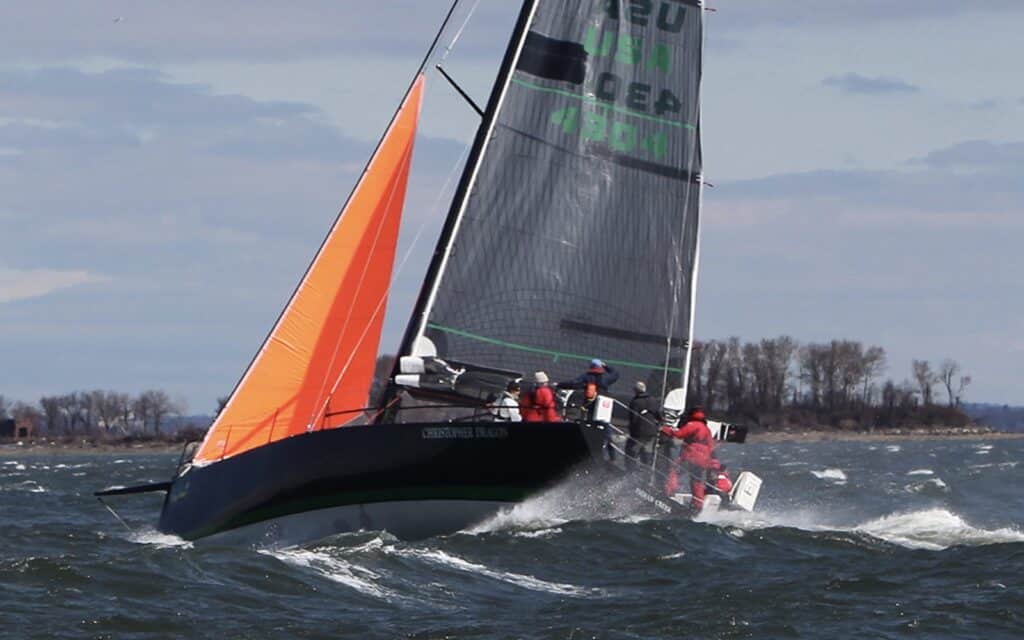
Sydney 43, Christopher Dragon, practicing a crew overboard recovery at the 2014 Storm Trysail Club’s Safety at Sea seminar.
Storage matters almost as much as practice. A storm jib at the bottom of a cockpit locker under six fenders and a cruising spinnaker is not accessible. It needs to be reachable in the dark, with cold hands, while the boat is moving. Most offshore boats keep it in a labelled bag near the companionway or in a dedicated forward locker. When you bag it, pre-attach the sheets and a correctly sized tack pennant, so that when you pull it out in 40 knots, some of the rigging work is already done.
Then there is the furler problem. Many cruisers assume their roller furler will handle anything by simply rolling away more sail. Furling systems can jam at exactly the moment you need them most. A jammed furler with a fully deployed genoa in 45 knots is an emergency, and the storm jib is what you reach for once the furler stops being a tool and starts being a problem.
How to Choose the Right Storm Jib for Your Boat
Three factors drive the build: your I measurement, your J measurement, and how you plan to rig the sail. From there, the loft can design a sail that meets World Sailing OSR specs if you race, or a slightly different optimization if you cruise. You also need to decide how the sail attaches.
One detail worth thinking through early is tack height. The tack pennant (the line or fitting that connects the tack of the storm jib to the stay or deck fitting) determines how high the sail sits above the water. It needs to be high enough to keep the foot of the sail clear of breaking waves, but the height also affects your sheeting angle. The LP of a storm jib is short, and if the tack is too low, the clew ends up too far forward of your jib tracks to sheet properly. The goal is to set the tack height so the sail trims to the same lead car position as your No. 3 or No. 4 jib, which means no scrambling to move the lead block when you’re already in survival conditions. This is another reason to set the sail in moderate conditions first: so you can measure and mark the right pennant length before you ever need it.
Storm Jib Comparison
| Sail Type | Typical Use | Cloth Weight | Sets On | Best For |
|---|---|---|---|---|
| Storm Jib (purpose-built) | 30+ knots sustained | (+/−)10 oz dacron | Inner forestay or hanks | Offshore, bluewater, racing |
| Storm Sleeve | 30 to 45 knots | (+/−)10 oz dacron | Over a furled headsail | Coastal cruisers without an inner stay |
| Reefed Genoa (furled in) | Up to about 25 knots | Normal cruising weight | Roller furler | Generally not recommended above 25 knots |
If you know your boat’s I and J measurements and how you plan to rig the sail, the next step is talking to a loft that can build to your boat’s exact specs. UK Sailmakers has nearly 50 lofts worldwide, which means a builder near you can measure your rig in person and deliver a sail designed to your boat. Get a quote from your nearest UK Sailmakers loft.
Frequently Asked Questions
What is a storm jib?
A storm jib is a small, heavy-cloth headsail designed for use in winds above 30 knots sustained. Its area is limited to about 5% of the foretriangle height squared under World Sailing’s Offshore Special Regulations, and the cloth weight is typically around 10 oz dacron. The sail is built to keep a boat balanced and moving in conditions where a normal jib would either tear or overpower the boat.
How big should a storm jib be?
The maximum size under World Sailing OSR is 5% of the foretriangle height squared (0.05 × I²), with a luff length no longer than 65% of the I measurement. On a 40-foot boat with an I of 50 feet, that’s roughly 125 square feet. Most cruising storm jibs come in at 50 to 100 square feet depending on the boat. Smaller is generally better in real gale conditions, since a bigger sail in survival weather is harder to control and adds load to a rig that’s already working hard.
Can I use a reefed genoa instead of a storm jib?
You can, but you shouldn’t above 25 knots of sustained wind. A rolled genoa has a poor shape for heavy weather, the aerodynamic driving force sits too high and too far forward, and the UV-protected leech that ends up taking full load is not designed for that strain. Genoas furled into storm-jib size routinely tear at the leech under sustained heavy wind.
Where can I find a storm jib for sale?
A storm jib “off the rack” is rarely a good idea because the dimensions need to match your boat’s I and J measurements and your rigging setup. A custom loft will measure your rig, build to your specs, and finish the sail with the hardware your boat actually has. UK Sailmakers builds storm jibs at lofts around the world, all by hand and to your boat’s exact dimensions.
Do I need a storm jib for coastal sailing?
It depends on how exposed your sailing area is. If you sail waters where a front can move through faster than you can reach shelter, a storm jib is sensible insurance. If you sail in protected inland waters and always reach home within an hour or two, a deeply furled jib plus a deep reef in the main usually covers what you’ll realistically face.
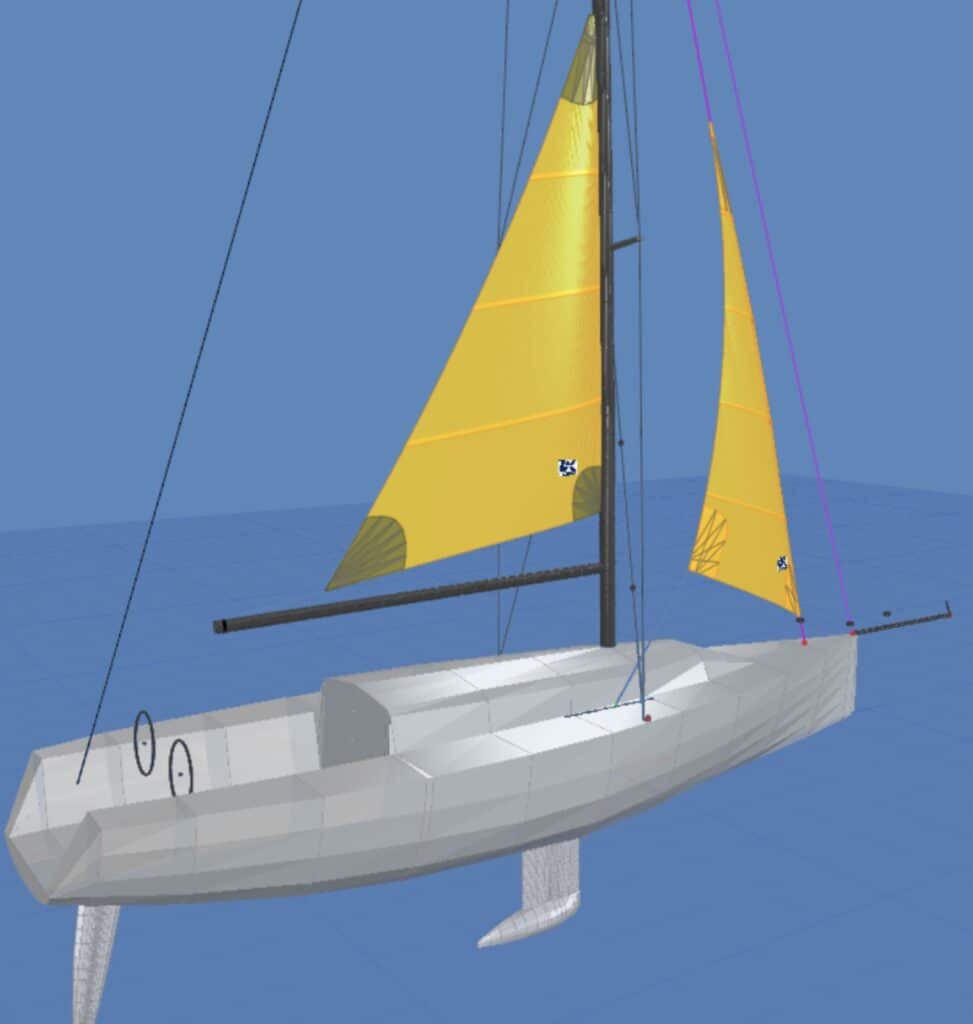
Your local UK Sailmakers loft will create custom storm sails for your boat and sailing conditions.
Why UK Sailmakers
A storm jib is a sail you might fly twice in a decade. When you fly it, nothing else on the boat matters more. That changes how we build it. The sails are reinforced beyond what the load calls for, because we’d rather over-build a sail you might use to save your boat than save a few yards of dacron. The hi-vis cloth is selected so it stays bright after years in a sail bag.
If you sail offshore, if you make coastal passages where weather can change faster than you can reach shelter, or if you simply want to know the boat is ready for whatever comes, talk to us. Get a quote from your nearest UK Sailmakers loft, and we’ll start with measurements and end with a sail that’s optimized for your boat.