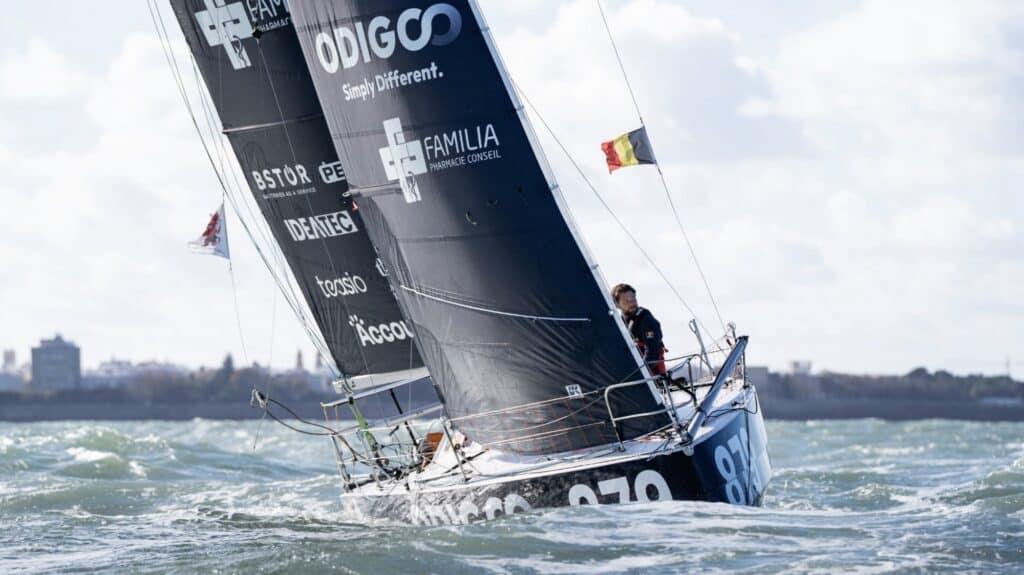
Belgian solo sailor Quentin Debois has been on standby in New York since August 5, watching the forecasts and waiting for the weather to hand him a route across the North Atlantic. His boat, the Mini 6.5 ODIGO, is in the water at Hudson Point Marina, fully prepared, inspected by the World Sailing Speed Record Council, and carrying a new UK Sailmakers mainsail. The only thing missing is the ideal departure window.
The Objective
Quentin is going after the singlehanded west to east North Atlantic record for boats under seven metres, New York to Lizard Point on the southwest tip of England. The time to beat is 17 days, 9 hours and 51 minutes, set by American sailor Jay Thompson.
His team has drawn a clear line for when they will send him. A routing has to show ODIGO arriving in England with at least five hours in hand on the existing record before they will commit to a start. Anything tighter than that gets passed over. On a crossing this long, five hours is a thin margin, and they want a real buffer rather than a coin flip.
That decision is being made day by day using two inputs: the weather models, which router Basile Rochu reviews every morning, and the boat’s polar, which is the performance table showing what ODIGO can actually do at a given wind angle and wind speed. Put the two together and you get an estimated arrival time in England.
The problem right now is that the models will not sit still. For one single potential departure date, the projected finish has swung by more than 80 hours over the course of 24 hours of forecasting, moving from well behind the record, to ahead of it, and back again. Quentin’s team describes this level of volatility as unusual rather than seasonal, and it is the reason they have not yet moved off red on their own three-stage alert system. Orange means a window may be opening. Green means he is going, and it will be called only a few hours before he crosses the line.
Standby is not a failure state. Before the January crossing, Quentin sat in Cádiz for four weeks before the weather cooperated. This one could run as long as six. Today and Saturday are both off the table. The next realistic opportunity is sometime next week, depending on whether the models settle into something worth chasing.


Achievements
Quentin only started sailing at 31, on a Hobie 16 on the Belgian North Sea. In the years since he has built a record that most sailors would take a lifetime to assemble.
In January he sailed east to west from Cádiz to San Salvador in The Bahamas by way of a Gran Canaria waypoint, covering the distance in 24 days and 19 hours and taking more than six days off the previous under-7m record of 30 days and 22 hours.
He followed that with a roughly 900 mile run from Miami to New York, establishing a world benchmark time in a category where no one had previously made an official attempt. He rode the Gulf Stream for an average two knot push, and at times three, until Cape Hatteras.
Both were done solo, without an engine, on a 21 foot offshore boat where trimming the boat means physically shifting around 250kg of internal ballast through every manoeuvre.
The Sail Inventory
UK Sailmakers Belgium have been the leaders on this project and built the original new sails for the Cádiz crossing: a reefable solent with a zipper reefing system, a Code 0, and A2 and A5 Matrix spinnakers. The reefable solent is the piece that earns its keep on a boat this size, since it lets one exhausted sailor change gear without going forward to swap a headsail in a seaway. The Matrix kites carried him through the trades, and on the Miami run he was flying them from the cockpit.
When his existing older mainsail needed work ahead of the Miami to New York attempt, UK Sailmakers Miami turned the repair around fast enough to keep the campaign on schedule.
For this crossing his new UK Sailmakers mainsail was shipped to the UK Sailmakers Northeast loft where he and the loft team stayed late two nights running to apply sponsor logos. Peak season at the loft means burning the midnight oil, but with a world record on the line, it was worth staying up for.
The project reflects the strength of the UK Sailmakers network as a whole. Expertise from across the group has contributed to optimizing the setup for these demanding record attempts, demonstrating what is possible when advanced sail design meets real-world offshore racing. It is a powerful reminder of what it truly means to Sail With Confidence.


Following Along
Quentin is characteristically level about the wait. As he puts it, standby is not “hot dogs and a stroll through Central Park.” There is always something on a boat to check, inspect or improve, and he is treating the delay as part of the work rather than an interruption to it.
You can hear him tell the story himself on UK Sailmakers’ Lessons Learned podcast, in Episode 26 on his Mini 6.5 campaign and in the Short recorded after the Miami to New York benchmark. Both are streaming on the UK Sailmakers YouTube channel, Spotify, Apple Podcasts and Amazon Music.
Once he starts, his team will publish daily updates on Instagram and Facebook, with live tracking available throughout the crossing.
Fair winds, Quentin. We will be following every mile.