

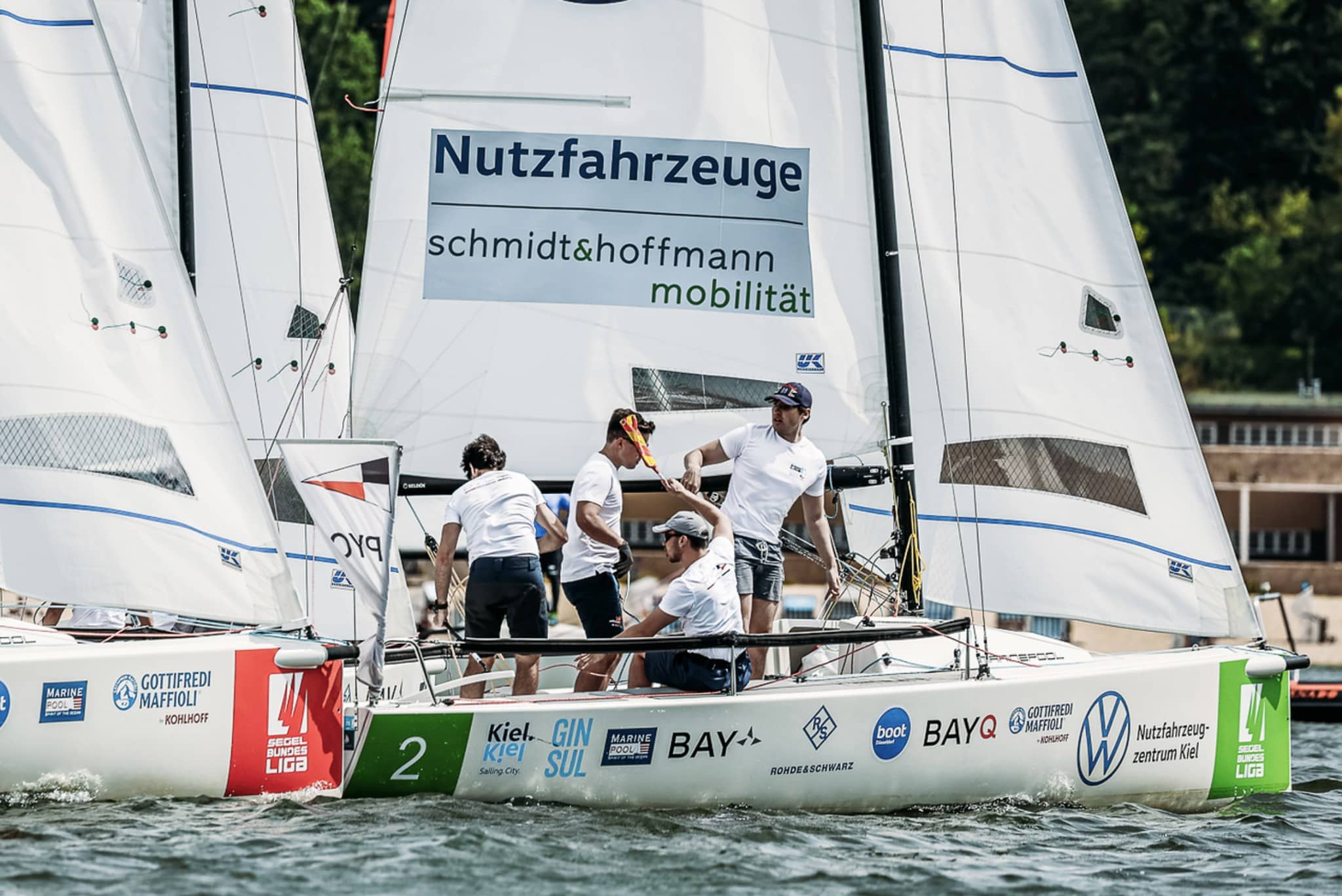
You’ve witnessed a rule breach on the water. Maybe a boat struck a mark, or forced you to take avoiding action. Now what? Understanding the protest process is essential for every racing sailor, whether you’re filing a protest or defending against one.
Competitors are governed by the Racing Rules of Sailing (RRS), which they are responsible not only for following, but also for upholding. A core principle of sportsmanship is that when a boat breaks a rule and is not exonerated, they will promptly take an appropriate penalty. That may be a penalty turn, a scoring or time penalty, or in some cases, retirement from the race.
Remember that even if you have the right of way, you are required to avoid contact if it is reasonably possible (RRS 14). Keep in mind that a right-of-way protest is valid if you can show you were forced to take evasive action to avoid a collision. Ultimately, winning a protest is small consolation for a shredded spinnaker, a damaged hull, or an injured crew member!
On the Water: Immediate Actions
When You Witness a Breach
Time is critical when you observe a rule breach. Under RRS 60.2, your immediate actions determine whether your protest will be valid:
- Hail “Protest” Immediately – Shout “Protest!” at the first reasonable opportunity after the incident. Your hail must be loud enough for the other boat to hear in the prevailing conditions. Using other words like “You fouled me!” or “Do your circles!” does not satisfy the requirement for a protest.
- Display Your Red Flag – If your boat is longer than 6 meters, you must conspicuously display a red protest flag at the first reasonable opportunity. This flag must remain flying until you have finished and are completely clear of the finishing area. Keep your protest flag ready and within reach; scrambling to display your flag is the fastest way to have your protest tossed for being invalid before the facts are even heard.
- Note the Details – While still on the water, record critical information: boat sail numbers, time of incident, approximate location, the positions of the boats involved, wind conditions, and the names of crew who witnessed the incident.
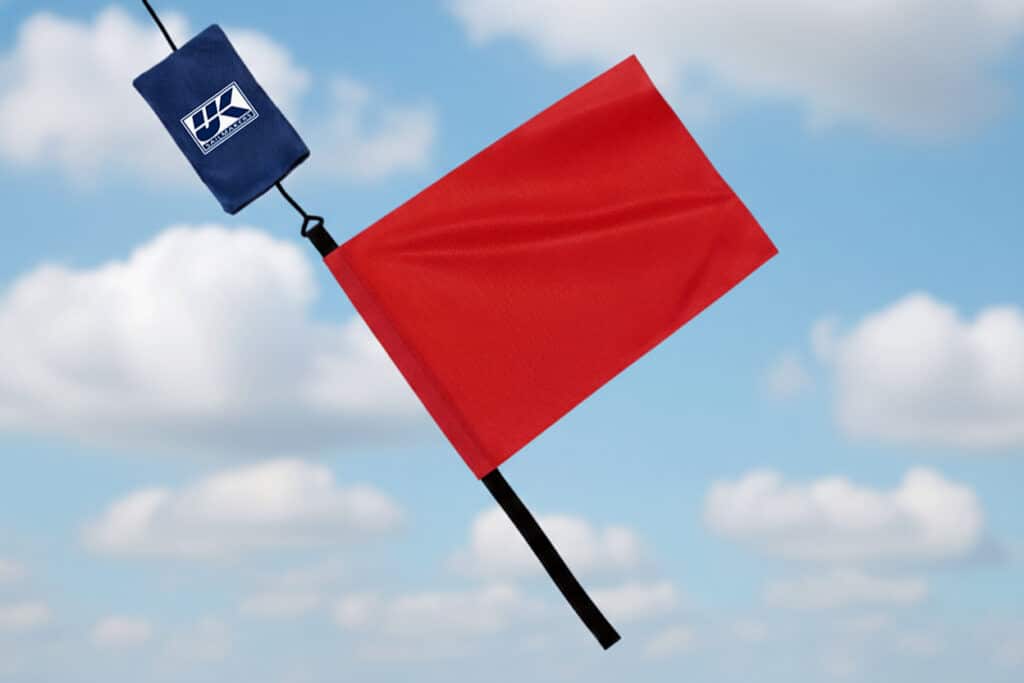
It’s a good idea to store a protest flag in a UV-resistant pouch, attached in a visible and accessible and conspicuous location, such as on the backstay. Make sure all crew members know its location and how to deploy it quickly.
Important Exceptions
You are NOT required to hail or display a flag if:
- The protestee was not within hailing distance at the time
- The incident was an error in sailing the course
- You did not observe the incident in the racing area
- Injury or serious damage has occurred (though you should attempt to inform the other boat of your intention to protest)
Back on Shore: Filing Your Protest
The Protest Time Limit
Under RRS 60.3, you have a strict deadline to file your written protest:
- For incidents observed in the racing area: Two hours after the last boat in the race finishes.
- For other protests: Two hours after the relevant information becomes available to you.
Note: The Sailing Instructions may specify a different time limit—always check before racing.
Writing Your Protest
Your written protest must clearly identify:
- The protestor (your boat name and sail number)
- The protestee (the other boat’s name and sail number)
- The incident (when, where, and what happened)
Deliver your protest to the race office (or by the method stated in the Sailing Instructions) before the time limit expires. Many clubs provide protest forms, but any written document that includes the required information is acceptable.
Preparing for the Protest Hearing
Before the Hearing
Preparation is key to presenting an effective case:
- Draw a diagram showing boat positions, courses, wind direction, and marks. Use simple shapes and clear labels. This will be your primary visual aid.
- Identify your witnesses and brief them on what they observed. Consistent, factual testimony strengthens your case.
- Review the relevant rules. Knowing the rule number, and understanding what it means, will help you to make an effective case. However, if the committee decides a boat broke a rule, it will apply the appropriate rule whether or not you mentioned it specifically.
- Prepare your timeline with specific details: distances between boats, exact actions taken, and the sequence of events.
- Consider the other boat’s likely defense and prepare responses to potential counterarguments.
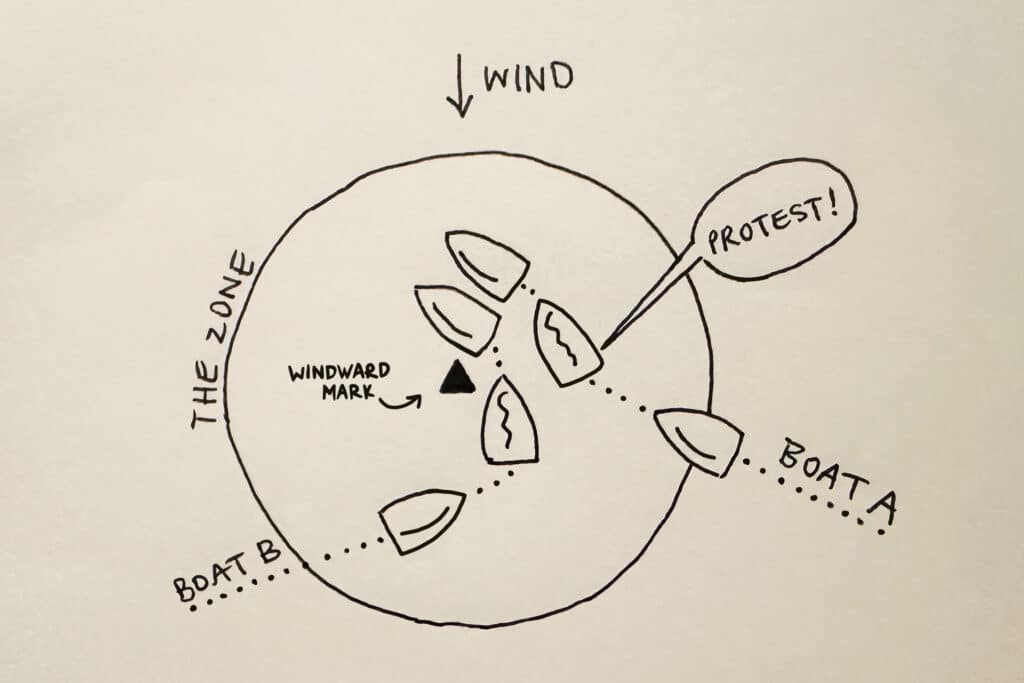
Don’t worry, you won’t be judged on artistic talent! Just try to make your diagram as clear as possible.
Your Rights Under RRS 63.1
As a party to the hearing, you are entitled to:
- Be informed of the time and place of the hearing
- Access the protest or request for redress being considered
- Reasonable time to prepare
- Have a representative present throughout the hearing (though in protests involving RRS Part 2, 3, or 4 breaches, representatives must have been on board during the incident unless the protest committee decides otherwise)
- Question any person giving evidence
In the Protest Room: The Hearing
The Hearing Process
Under RRS 63.4 and 63.5, the protest committee follows a structured process:
- Validity check – The committee first determines if your protest is valid (proper hail, flag, written protest within time limit).
- Evidence taking – Each party presents their account, followed by witnesses (if applicable). Both parties may question the witnesses.
- Finding facts – The committee determines what happened based on the balance of probabilities.
- Applying rules – The committee applies the Racing Rules of Sailing to the facts.
- Decision and penalty – If a boat broke a rule, the committee imposes the appropriate penalty (typically disqualification unless exonerated).
Presenting Your Case Effectively
- Stick to facts, not opinions. Say “The boats were overlapped” not “I think we were overlapped.”
- Use your diagram. Point to positions as you describe the incident.
- Be specific about distances and timing. “Two boat lengths” is more helpful than “close.”
- Remain respectful and calm. The committee is there to determine facts, and apply the rules fairly to all parties, not to assign blame or take sides.
- Let the committee ask questions. Don’t interrupt or argue with the other party during their testimony.

After both parties have presented their case, the protest committee will typically take some time to deliberate among themselves in private before coming to a decision.
Common Protest Scenarios
Here are some frequent situations and the key considerations:
| Scenario | Rules Involved | Key Evidence to Gather |
| Mark Touch | Rule 31 (Touching a Mark) | What part of the boat touched? Was boat racing? Did they take a penalty turn? |
| Port/Starboard Incident | Rule 10 (Port-Starboard) | Tacks of both boats, whether contact occurred, whether the starboard boat had to alter course. |
| Room at Mark | Rule 18 (Mark-Room) | Were boats overlapped at the zone? Which boat was inside? Was room given? Did contact occur? |
| Incorrect Sail Numbers | Appendix G (Identification on Sails) | Photos of sail numbers, rules on measurement, style, placement, spacing and contrasting colors. |
| Sailed Wrong Course | Rule 28 (Sailing the Course) | Which mark was missed or rounded incorrectly? GPS track if available, witness statements. |
After the Decision: Appeals and Reopening
Under RRS 63.6, the protest committee will inform all parties of the facts found, applicable rules, decision, reasons, and any penalties. If you believe the decision was incorrect, you have options:
Requesting a Reopening (RRS 63.7)
You may request a reopening if:
- You were unavoidably absent from the hearing
- The committee may have made a significant error
- Significant new evidence has become available
Deliver your written request to the race office within 24 hours of being informed of the decision (or within the protest time limit if on the last day of racing and you were informed of the decision on that day).
Right to Appeal (RRS 70)
You may appeal the protest committee’s decision or procedures (but not the facts found) to your national authority, unless:
- The decision was made by a properly constituted international jury
- The Sailing Instructions state that no appeal is allowed (with appropriate national authority approval)
Appeals must conform to Appendix R of the RRS and follow your national authority’s procedures.
Check Your Race Documents: Common Modifications
Many events modify the standard rules through their Sailing Instructions. Often, modifications and amendments will be discussed at the skippers meeting, having a representative in attendance is strongly encouraged. Always review the Sailing Instructions and Notice of Race, including any posted amendments carefully before racing. Common modifications include:

Penalty Systems
- Turn penalties: the standard Two-Turn penalty (promptly making two turns in the same direction, each turn including one tack and one gybe) may be changed to a One-Turn penalty for less serious breaches.
- Scoring penalties: Some events (especially match racing) use percentage penalties instead of turns.
- Arbitration: Some events offer pre-hearing arbitration where parties can admit fault and take a lesser penalty, and avoid the full hearing.
Scoring Codes
Special codes like NSC (Did Not Sail the Course) allow the race committee to apply penalties without a formal hearing in certain circumstances.
Time Limits
Events may establish specific time limits for the first boat to finish and create finishing windows for subsequent boats, after which boats will be scored Did Not Finish (DNF).
Class Rules
Sailing Instructions may explicitly allow or disallow specific class rule changes, particularly regarding rigging, equipment, or sail configurations.
The Fast Track: On-Water Judges & Umpires
Not every protest ends in a crowded room at the yacht club. Depending on your Sailing Instructions, the “playbook” might happen in real-time. In high-level regattas, Judges often watch for illegal pumping or rocking. If they flag you, there is no hearing and you must take your penalty immediately. Umpires are also common in match racing, they signal their penalty rulings using a combination of colored flags and sound signals. Refer to the RRS Appendix C5 for more information on Umpire signals.
Final Thoughts
The protest process exists to maintain fairness and sportsmanship in our sport. While no one enjoys being involved in a protest, understanding the system helps ensure that racing is conducted according to the rules we all agree to follow. Whether you’re filing a protest or defending against one, preparation, clarity, and respect for the process will serve you well.
Remember, protests are not personal attacks—they’re part of how we maintain the integrity of fair competition on the water.
Important Note: This guide is for educational purposes only and provides general information about the protest process under the Racing Rules of Sailing. Always refer to the current edition of the Racing Rules of Sailing (at the time of this publication, 2025-2028) and check for any modifications to the rules in your event’s Sailing Instructions. When in doubt, consult with experienced race officers or protest committee members at your club.
Edited March 2, 2026: This article has been updated with suggested changes and clarifications submitted by Algis Patasius, National Judge, LTU.



Thank you for your response to my comments. I am always interested in the articles you publish on ‘UK Sailmakers…’, especially those on RRS explanations and application. Kind Regards, Algis Patasius.