
This spring, I started racing doublehanded to respect social distancing requirements. Since then, my long-time crewmember Gerard Girstl and I have been working on our boat-handling and sail-handling techniques. In an early season race we finished second in a 45-mile race because we didn’t have a system to peel from the fractional Code Zero to a masthead spinnaker. As a result, we had to sail on a broad reach with our code zero for five miles, which allowed our competition catch up. The next weekend, we practiced the code zero to spinnaker peel that Gerard had worked out.
Here’s what he came up with.
- Bring the new spinnaker bag on deck, attach the new sheets.
- Not having a second tack line, the new spinnaker tack is attached to a strop around the base of the sprit.
- The spinnaker is raised while secured in Velcro stops.
- To make it easier to gather the code zero, we have a retrieval line attached to the bail of the tack line shackle. That line is led through a snatch block attached to a fitting on the foredeck in front of the forward hatch, and then back to a winch in the cockpit. Being in the cockpit, I ease out the tackline and pull in the retrieval line until the code zero tack is at the block on the foredeck.
- Now the code zero halyard is lowered, and the sail is stuffed down the hatch.
- The tack line is unshackled from the code zero and transferred to the spinnaker.
- The shackle on the strop is spiked
- The track line is winched to bring the spinnaker tack to the end of the pole.
- The boat is turned up to fill the sail.
This maneuver took just over two minutes from start to finish. While not fast for a fully crewed team, it is much faster than a baldhead change.
Pro tip #1: Had the code zero been set-up with a roller furler, we would have furled it, then before dropping it down the forward hatch.
Pro tip #2: Transferring from the strop to the tack line could have been avoided if we had a second tackline, which we don’t.
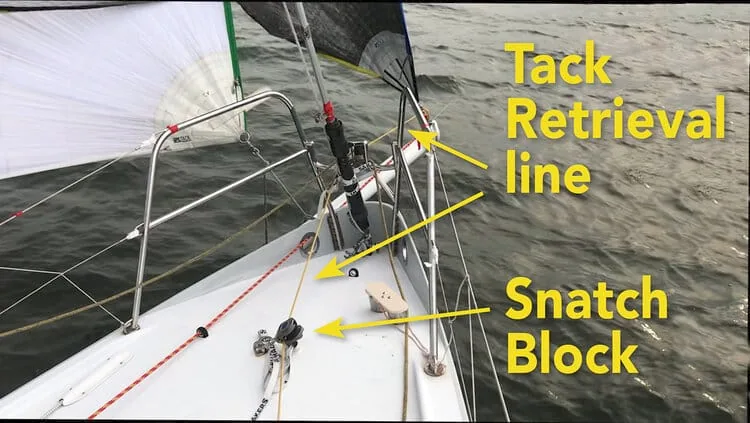
With this tack retrieval line set up, the crew member in the cockpit can winch the tack of the code zero from the end of the pole to the middle of the foredeck so that it can be gathered easier.
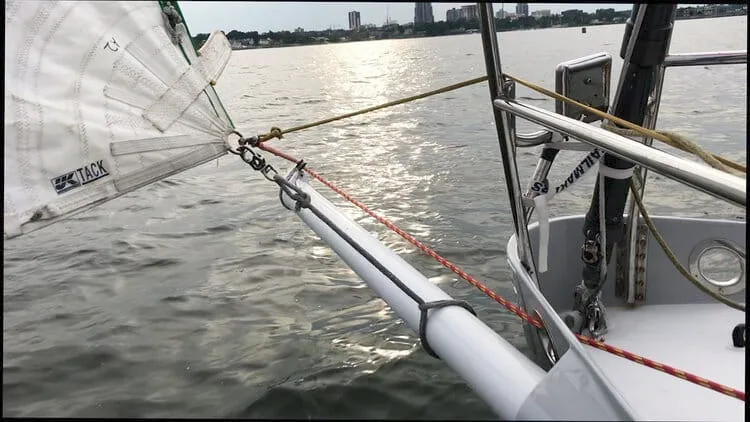
This picture shows the changing strop, the tackling (red) and the retrieval line (yellow). In the picture the tackling is being tightened to move the spinnaker tack out to the end of the sprit.
More on doublehanded racing
Tips for Doublehanded Racing
The immense popularity and exploding interest in big boat doublehanded sailing is branching out from its competitive roots in northern Europe to now engulfing nearly every…
BACK TO HANKS
Doublehanded racing was growing in popularity for over a decade. With the interruption to big boat racing caused by the worldwide pandemic, doublehanded racing has taken off…
Doublehanding Primer
View fullsize An L30 One-Design, which is one of the boats being considered for the mixed offshore doublehanded Olympic sailing event in 2024. The supplied class sails for…
My First Doublehanded Race
Of course, my first doublehanded race of 2020 had to be sailed in 18-26 knots – trial by fire. It was a 20-mile race where the course was a 10-mile dead run followed by a…
How to gybe singlehandedly
By Adam Loory, General Manager of UK Sailmakers International Thanks to Covid 19’s requirement to sail socially distanced, I discovered the fun of doublehanding and…
Planning ahead
Last summer I sailed a 100-mile doublehanded race. The course was to a mark 50 miles to the east and back. On the way out, thunderstorms were moving to the east with us. We…