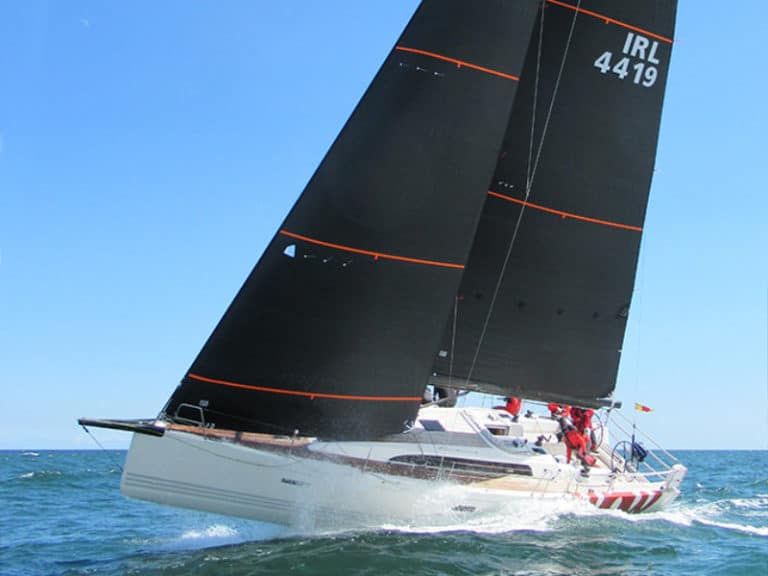
RACING HEADSAILS
Titanium Racing Headsail
Advanced carbon-fiber load paths for unmatched strength, shape retention, and upwind performance — Titanium jibs and genoas for grand-prix teams, pro programs, and serious cruisers.

Why a Titanium Headsail?
UK Sailmakers’ Titanium® headsails use advanced carbon-fiber technology to deliver unmatched strength, shape retention, and performance. Titanium jibs, genoas, and specialty sails can be finished with either LiteSkin® or taffeta to suit grand-prix racing teams, professional programs, and serious cruisers alike. UK Sailmakers pioneered load-path sails three decades ago with the Tape-Drive® method, in which the aerodynamic loads are carried not by the cloth and seams but by bundles of high-strength yarns running continuously between the corners of the sail.
A Titanium headsail takes that idea to its peak: a grid of continuous carbon yarns runs unbroken between the three corners, laminated between two layers of 3D-shaped PET film that act as the sail’s protective epidermis. The yarns are laid dry — without glue — to save weight and keep the carbon from going brittle, which also leaves them more flexible and makes the finished sail 15–30% more durable. For sailors chasing the ultimate in upwind performance, ISL (Integrated Structural Luff) technology is now available for new Titanium headsails.
Ultimate Upwind Performance
Grand-prix-level shape
Continuous carbon load paths give Titanium headsails unmatched strength and shape retention — the choice of grand-prix teams and pro programs.
Dry-Laid Carbon
No glue, more life
Laying the load-path yarns dry keeps them light and flexible and the carbon from going brittle — for headsails that last 15–30% longer.
Smooth Out of the Bag
No seam loads, no wrinkles
Corner-to-corner yarns carry the loads instead of the seams, so the sail sets wrinkle-free and holds its designed shape.
How a Titanium Sail Is Built

The PET film is the heart of a Titanium sail’s lamination “sandwich.” Incredibly thin yet incredibly tough, it’s the same material used in plastic bottles and some paper currencies — try tearing either apart and you’ll feel how strong PET is. Sunlight and heat up to 50°C/120°F do nothing to it; it won’t even shrink the way many similar films do.
The inner side of each PET skin is tacky from a copolymer coating. As the carbon yarns are laid down, that stickiness holds them in place until lamination is complete. The skin-yarn-skin sandwich is then placed on a variable-geometry thermoform “oven,” where it’s UV- and heat-bonded under one bar of vacuum pressure into a one-piece sail. The copolymer melts around the carbon fibers, creating a single-layer structure that’s substantially stronger than the sum of its parts.
Yes, a Titanium sail has seams — but they exist only to shape the film layers, not to carry load. In most high-tech sails the structural yarns run only the width of a single panel, so the seams take the strain. A Titanium sail’s corner-to-corner continuous yarns eliminate seam loads, load-induced distortion, wrinkles, and seam failure. The sail comes out of the bag smooth and wrinkle-free, and stays that way.

LiteSkin or Taffeta — Your Choice
Titanium sails used to leave the PET film bare on the outside, which left it open to damage from tacking and everyday handling. Today you can order a Titanium headsail with its outer film covered in either LiteSkin® or taffeta. Both extend the sail’s peak-performance life — with no noticeable increase in weight.

LiteSkin
Lightest protection
A thin, lightweight sheet of random, non-woven polyester filaments applied to the outer surfaces, giving the sail a matte-black or dark-grey look. A proprietary product of Dimension-Polyant Sailcloth, it comes in two weights: 10×10, and a lighter 5×5 that’s half the weight of the original.
Taffeta
More rugged
A lightweight, finely woven polyester cloth laminated to the Titanium film. Like LiteSkin, it protects the sail and extends its competitive life — slightly heavier, but tougher and more abrasion-resistant for harder use.

FAQs
What makes a Titanium headsail different from a paneled laminate sail?
In most high-tech sails the structural yarns run only the width of each panel, so the seams carry the load. A Titanium sail’s carbon yarns run unbroken from corner to corner along the actual load paths, which eliminates seam loads, load-induced distortion, and wrinkles. The seams are there only to shape the film, not to hold the sail together.
Why are the carbon yarns laid dry, without glue?
Skipping the glue keeps the yarns lighter and more flexible and stops the carbon from going brittle, which makes the finished sail 15–30% more durable. That means better shape retention and far fewer sails to replace.
What is ISL?
ISL — Integrated Structural Luff — is an option for new Titanium headsails that builds structural reinforcement into the luff for the ultimate in upwind performance. See our ISL page for the full details, and talk to your loft about adding it to your next sail.
Should I add LiteSkin or taffeta?
Both protect the PET film from tacking and handling damage and extend the sail’s competitive life with almost no weight penalty. LiteSkin is a non-woven polyester surface — lighter, with a matte-black look, in 10×10 and a lighter 5×5 weight. Taffeta is a finely woven polyester that’s slightly heavier but more rugged. The choice comes down to how hard the sail will be used.
Will it hold its shape?
Yes. Because the continuous corner-to-corner yarns carry the loads rather than the seams, a Titanium sail comes out of the bag smooth and wrinkle-free and stays that way, holding its designed shape far longer than a paneled sail.